

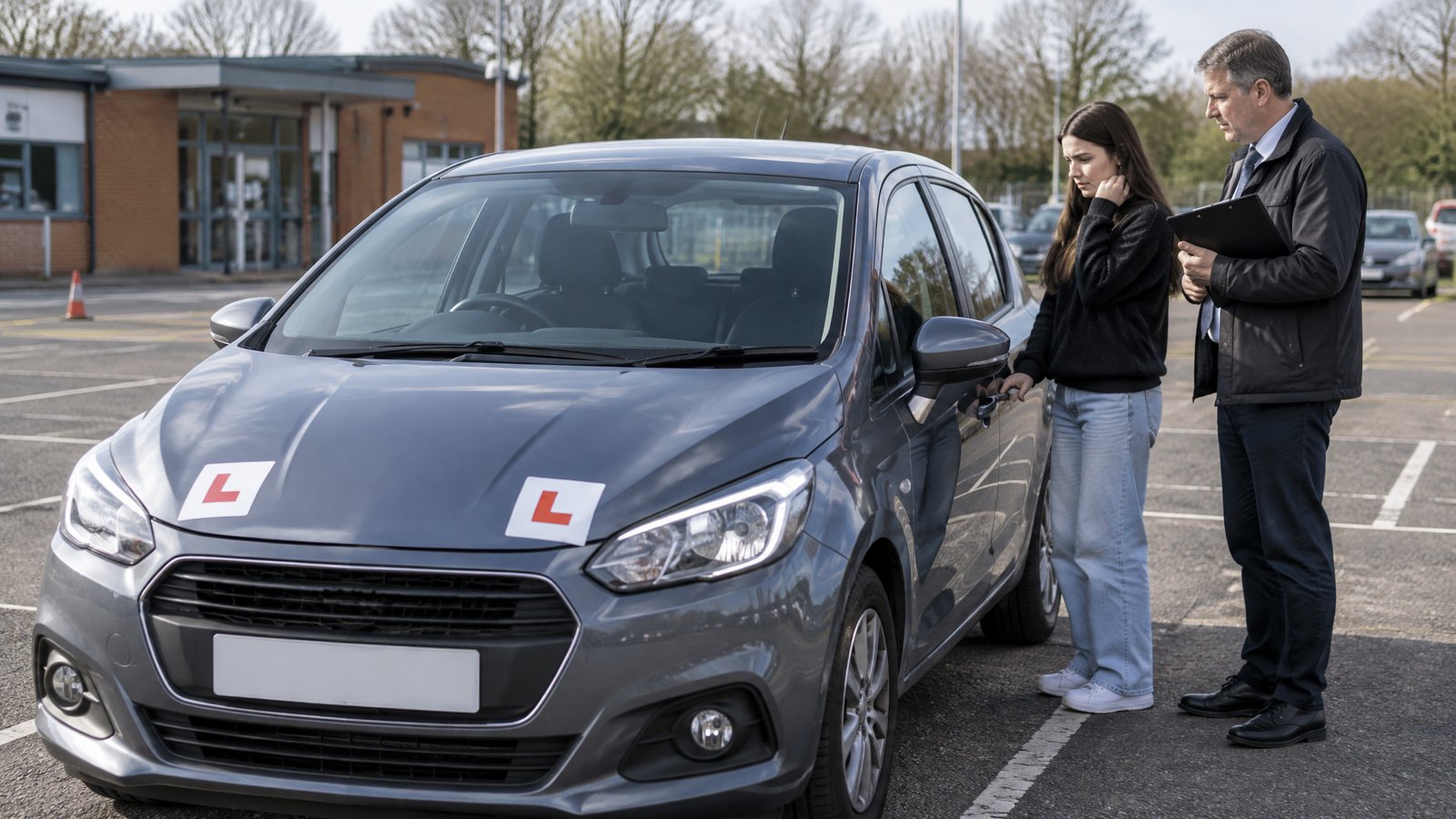
Is it a fault? Driving test fault checker
Examiners judge each situation. These examples show how DVSA guidance grades common mistakes; they are not a guarantee of your result.
Type a mistake to see how it could be marked. You pass with up to 15 driving faults and no serious or dangerous faults. Read more in our practical driving test guide and the driving test FAQ.
Showing 30 of 30 mistakes
Stalling
Driving fault (minor)
You stall while waiting at quiet lights, then restart calmly and safely.
Serious fault
You stall again and again at a junction, holding up traffic behind you.
Dangerous fault
You stall halfway across a busy junction and an approaching car has to brake hard.
Touching the kerb
Driving fault (minor)
You lightly brush the kerb with a tyre while pulling up on the left.
Serious fault
You mount the kerb during a manoeuvre, even with no one around.
Dangerous fault
You mount the pavement where people are walking.
Mirrors before moving off
Driving fault (minor)
You forget one mirror check when pulling away on an empty road.
Serious fault
You pull away without checking, and a cyclist behind has to slow down.
Dangerous fault
You pull out without looking and a car has to swerve to avoid you.
Mirrors when changing speed or direction
Driving fault (minor)
You slow down for a turn without checking your mirror, with nobody close behind.
Serious fault
You change lanes without a mirror check while traffic is following closely.
Dangerous fault
You brake sharply with no mirror check and the car behind nearly hits you.
Signals
Driving fault (minor)
You leave your indicator on for a short time after a turn.
Serious fault
You signal left but turn right, confusing other drivers.
Dangerous fault
A misleading signal makes another driver pull out in front of you.
Blind spot checks
Driving fault (minor)
You skip a blind spot check before pulling away on a clear, quiet road.
Serious fault
You skip the blind spot check when moving off next to parked cars and a cyclist.
Dangerous fault
You pull out without a blind spot check, straight into the path of a motorbike.
Driving too slowly
Driving fault (minor)
You drive at 20 mph on a clear 30 mph road for a short stretch.
Serious fault
You drive at 40 mph on a clear 70 mph dual carriageway, holding up traffic.
Dangerous fault
You crawl on a fast road so that other drivers make risky overtakes.
Speeding
Driving fault (minor)
You are slow to notice a lower limit sign, but slow down before going over it.
Serious fault
You stay clearly over the speed limit.
Dangerous fault
You drive far too fast for the road near a school or busy crossing.
Hesitation at junctions
Driving fault (minor)
You wait a little longer than needed before taking a safe gap.
Serious fault
You miss several safe gaps and hold up traffic behind you.
Dangerous fault
You start to pull out, stop, then go again, so other drivers must brake.
Bay parking
Driving fault (minor)
You finish slightly over the line but correct it with care.
Serious fault
You end up across two bays or need many shunts to finish.
Dangerous fault
You reverse into the path of a moving car or a person walking behind you.
Parallel parking
Driving fault (minor)
You stop a bit far from the kerb but still parked safely.
Serious fault
You hit the kerb hard or finish far from the kerb.
Dangerous fault
You swing the front of the car into the path of passing traffic.
Pulling up on the right
Driving fault (minor)
You reverse slightly less than two car lengths.
Serious fault
You cross the road without good checks for traffic.
Dangerous fault
You pull across into oncoming traffic, which has to brake.
Hill start roll-back
Driving fault (minor)
You roll back a few centimetres with nobody behind you.
Serious fault
You roll back a long way before you get the car under control.
Dangerous fault
You roll back towards a car or person behind you.
Position at junctions
Driving fault (minor)
You are not quite central in your lane when turning right on a quiet road.
Serious fault
You cut the corner when turning right.
Dangerous fault
You cut the corner into the path of a car waiting to come out.
Emerging from junctions
Driving fault (minor)
You creep forward slowly at a give way line with poor early checks, but take a safe gap.
Serious fault
You pull out and a car on the main road has to slow down.
Dangerous fault
You pull out and a car on the main road has to brake hard or swerve.
Roundabout lanes
Driving fault (minor)
You forget to signal left before your exit on a quiet roundabout.
Serious fault
You use the wrong lane on a busy roundabout.
Dangerous fault
You cut across another lane on the roundabout into the path of a car.
Pedestrian crossings
Driving fault (minor)
You approach a zebra crossing a little fast but stop smoothly in time.
Serious fault
You fail to stop for someone waiting to cross at a zebra crossing.
Dangerous fault
You drive on while someone is stepping onto the crossing.
Yellow box junctions
Driving fault (minor)
You stop with a small part of the car on the edge of the box.
Serious fault
You enter the box when your exit is not clear and stop inside it.
Dangerous fault
You stop in the box and block emergency vehicles or crossing traffic.
Traffic lights
Driving fault (minor)
You stop slightly over the stop line at a red light.
Serious fault
You drive through on amber when you could have stopped safely.
Dangerous fault
You drive through a red light.
Following distance
Driving fault (minor)
You get a bit close to the car in front for a short time, then drop back.
Serious fault
You follow far too closely for the speed you are doing.
Dangerous fault
The car in front brakes and you only just avoid hitting it.
Meeting oncoming traffic
Driving fault (minor)
You wait a bit too long when you had space to pass parked cars first.
Serious fault
You push through a narrow gap and an oncoming car has to stop.
Dangerous fault
You squeeze through and an oncoming car has to brake hard or mount the kerb.
Clearance to parked cars and cyclists
Driving fault (minor)
You pass parked cars a little close on an empty street.
Serious fault
You pass a cyclist without leaving enough space.
Dangerous fault
You pass so close to a cyclist that they wobble or have to move over.
Steering control
Driving fault (minor)
You steer a little late, so the car drifts slightly in your lane.
Serious fault
You steer late and drift over the centre line on a bend.
Dangerous fault
You lose steering control and drift towards an oncoming car.
Gears
Driving fault (minor)
You pick the wrong gear briefly and correct it.
Serious fault
You coast in neutral down a hill and lose control of your speed.
Dangerous fault
A bad gear change makes the car lurch towards other road users.
Road signs and markings
Driving fault (minor)
You drift over a lane line for a moment on an empty road.
Serious fault
You ignore a no right turn sign.
Dangerous fault
You drive the wrong way into a one-way street.
Awareness and planning
Driving fault (minor)
You brake a bit late for a hazard you could have seen earlier.
Serious fault
You do not react to a bus pulling out until you have to brake firmly.
Dangerous fault
You miss a child running into the road and the examiner has to act.
Response to other road users' signals
Driving fault (minor)
You are slow to move over safely for an emergency vehicle.
Serious fault
You ignore a police officer directing traffic.
Dangerous fault
You move over for an ambulance in a way that puts others at risk.
Emergency stop
Driving fault (minor)
You react a little slowly when the examiner gives the signal.
Serious fault
You lose some control and the car skids.
Dangerous fault
You do the stop without control and the car slides off line.
Show me / tell me questions
Driving fault (minor)
You answer one or both questions wrongly. That is one driving fault in total.
Serious fault
You lose control of the car while doing a show me task on the move.
Dangerous fault
You look down too long at the controls and drift towards a hazard.
Examiner has to step in
Driving fault (minor)
Not a minor: any time the examiner has to act it is graded at least serious.
Serious fault
The examiner gives a spoken warning to stop you making a mistake.
Dangerous fault
The examiner uses the dual brake or takes the wheel to avoid danger.
Want to test yourself? Try the practice tests.
Examples written in our own words, based on DVSA: Carry out mock driving tests for your pupils. Crown copyright. Contains public sector information licensed under the Open Government Licence v3.0. moValue is not connected to DVSA.