

Hazard perception test tips
The hazard perception test is the second part of the car theory test. Lots of learners find it harder than the questions. That's because it tests timing, not just knowledge. The good news is that it is a skill you can practise. This guide explains how it works and how to spot hazards early.
Quick summary
- You watch 14 video clips with 15 developing hazards in total.
- Each hazard can score up to 5 points. You need 44 out of 75 to pass.
- Click as soon as you see a hazard start to develop. Earlier clicks score more.
- Clicking all the time, or in a pattern, scores 0 for that clip.
- Practise spotting clues, like a parked car's indicator or a cyclist looking back.
How the test works
You watch 14 short video clips filmed from a driver's point of view. They show everyday roads: town streets, country lanes, junctions and dual carriageways.
Each clip has at least one developing hazard. One clip has two. So there are 15 hazards in total.
You click the mouse when you see a hazard starting to develop. You can score up to 5 points for each hazard. The top score is 75, and you need 44 to pass.
You only get one go at each clip. You cannot pause, rewind or change your clicks.
Example: 44 out of 75 works out at about 3 points per hazard. So you don't need to be perfect. You just need to be fairly quick, most of the time.
Potential hazards and developing hazards
This is the most important idea in the test.
A potential hazard is something that could become a problem, but isn't one yet. You should watch it, but you don't need to slow down or steer yet.
A developing hazard is something that is becoming a problem. It would make you take action, like slowing down, stopping or changing direction. Only developing hazards score points.
Example: A car is parked at the side of the road. Nothing is happening, so it is a potential hazard. As you get closer, its right indicator starts flashing and it begins to pull out. Now you would need to slow down. It has become a developing hazard.
Example: A man is standing on the pavement near the kerb. That is a potential hazard. He steps into the road without looking. That is a developing hazard.
How the scoring works (5-4-3-2-1)
For each developing hazard there is a hidden "scoring window". It opens the moment the hazard starts to develop.
- Click early in the window and you score 5.
- A bit later scores 4, then 3, then 2, then 1.
- Click after the window closes and you score 0.
- Click before the window opens and that click scores 0 too.
That last point surprises many people. If you click too early, that click doesn't count. So it's sensible to click again when things start to change. Only your best click for each hazard counts.
You do not lose points for clicking at the wrong thing. But see the next section.
Example: You click when you first see a ball roll into the road. Then you click again when a child runs after it. If the first click came before the window opened, your second click still scores.
Why clicking in a pattern scores 0
The test is designed to catch people who try to cheat the system. If you click non-stop, or in a regular rhythm (like click-click-click every second), you score nothing for that whole clip.
So don't panic-click. Click with a reason each time.
Example: Tom clicks ten times quickly as soon as a lorry appears. The computer sees a pattern and gives him 0 for that clip, even though he did see the hazard.
A practical way to click
Note: This is a common tip from driving instructors. It is not an official DVSA rule.
Many instructors suggest clicking in up to three stages for each hazard:
- First click: when you first see something that could develop. For example, a child near the kerb.
- Second click: when it starts to develop. For example, the child turns towards the road.
- Third click: if it gets worse. For example, the child steps off the kerb.
This covers you if your first click was too early. It also stays calm and spaced out, so it shouldn't look like a pattern. Many instructors also suggest staying well below about 10 clicks in one clip.
Example: A cyclist is riding ahead (click 1). They look over their shoulder (click 2). They move out to go round a parked car (click 3).
What to look for: clues that a hazard is coming
Good drivers spot clues before things happen. Train your eyes to look for:
- Movement: wheels starting to turn, people stepping forward.
- Lights: indicators, brake lights, reversing lights.
- People's heads: a cyclist or pedestrian looking around often means they are about to move.
- Gaps: spaces between parked cars where someone could appear.
- Reflections: a vehicle reflected in a shop window may be about to come out of a hidden exit.
Don't click for things that cannot move, like signs, traffic islands or road markings. They help you predict hazards, but they are not developing hazards themselves.
10 classic developing hazards
These come up a lot, in the test and in real life. Each one has a simple example of the moment it develops.
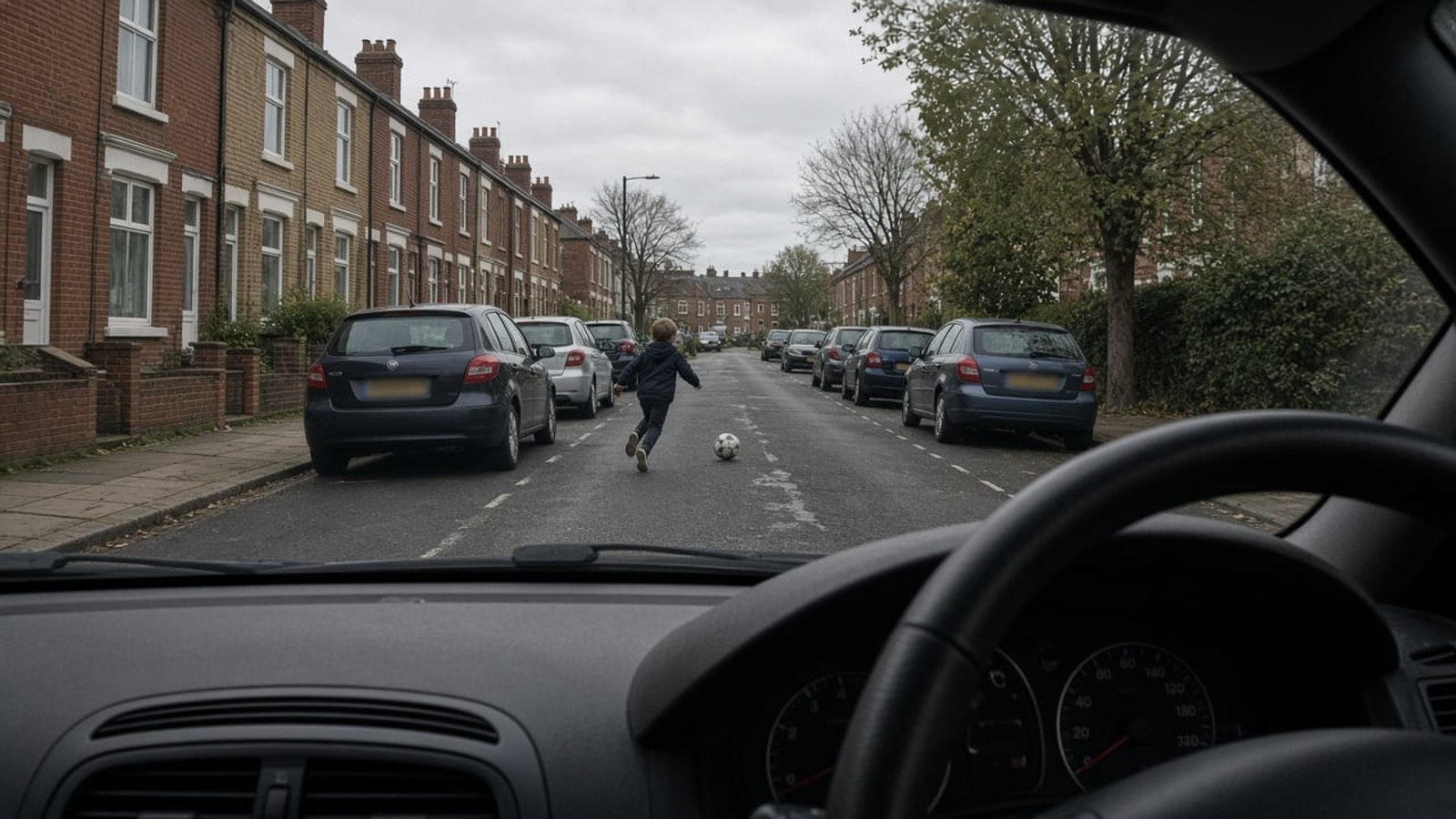
1. A child between parked cars Children are small and hard to see. Example: a football bounces out from between two cars, then a child runs out after it.
2. A car pulling out of a side road Drivers in side roads may not see you. Example: a car creeps forward at a junction on your left and then keeps going into your path.
3. A cyclist looking over their shoulder This often means they are about to move out or turn. Example: a cyclist looks back, then swings out to pass a parked van.
4. A bus pulling away from a stop You should give buses priority when it's safe. Example: a bus at a stop starts flashing its right indicator and moves off.
5. A horse rider Horses can be startled. You should slow to no more than 10 mph and pass at least 2 metres away. Example: a horse ahead on a country lane becomes jumpy when a tractor passes.
6. A pedestrian stepping off the kerb People on phones or in a hurry may cross without looking. Example: a woman waiting by the road suddenly steps out to cross.
7. A car door opening A parked car with someone inside could open its door. Example: you see a driver in a parked car, and the door swings open into the road.
8. A vehicle reversing out of a driveway White reversing lights are the clue. Example: a car's reversing lights come on and it starts backing out across the pavement.
9. Traffic slowing or stopping ahead Brake lights are the clue. Example: on a dual carriageway, the cars ahead brake hard because of a queue.
10. A motorcyclist at a junction or roundabout Motorbikes are small and fast and easy to miss. Example: a motorbike comes up quickly on your right as you wait to join a roundabout.
How to practise
- Use official clips. GOV.UK links to free practice clips that show how the test works. DVSA also sells official hazard perception apps.
- Practise on real roads. As a passenger, say out loud what you can see that might develop. This is called commentary driving.
- Learn the rules behind the hazards. Our free practice tests cover the Highway Code rules on cyclists, horses, pedestrians and buses.
- Don't over-practise one app. If you learn one set of clips by heart, you are learning the clips, not the skill. Mix it up.
Example: On the way to college, Sophie plays "spot the hazard" from the passenger seat. Her dad drives and she points out every cyclist, parked car and side road.
On the day
- You can take a break of up to 3 minutes after the multiple-choice questions.
- Sit comfortably. Keep your hand on the mouse and your eyes on the whole screen, not just the middle.
- Look far ahead and also check the edges of the picture, where people often appear.
- If you miss a hazard, forget it. Focus on the next clip.
To learn how the rest of the test works, read Theory test explained.
Frequently asked questions
How many clips are there in the hazard perception test?
There are 14 clips. 13 have one developing hazard and 1 has two, so there are 15 hazards in total.
What is the pass mark?
44 out of 75.
Do I lose points for clicking too much?
Not for clicking at the wrong thing. But if you click continuously or in a pattern, you score 0 for that clip.
Can I go back and watch a clip again?
No. You get one attempt at each clip.
What if I click before the hazard develops?
That click scores 0, because the scoring window hasn't opened yet. This is why it helps to click again as the hazard develops.
Is the "three clicks" method official?
No. It is a common tip from instructors. The official advice is to click as soon as you see a hazard starting to develop.
More from Learn to drive
Sources
Official figures in this guide come from the sources below. Ranges and examples not linked to a source are general guidance from our editors, not official statistics.
- gov.uk/theory-test
- gov.uk/theory-test/hazard-perception-test
- gov.uk/theory-test/pass-mark-and-result
- gov.uk/theory-test/multiple-choice-questions
- gov.uk/theory-test/revision-and-practice
- gov.uk/take-practice-theory-test
- gov.uk/guidance/the-highway-code/using-the-road-159-to-203
- gov.uk/guidance/the-highway-code/road-users-requiring-extra-care-204-to-225