

Practical driving test guide
The practical driving test is the last big step before your full licence. An examiner sits next to you and watches how safely you drive. This guide explains what happens, how faults work and how to give yourself the best chance.
Quick summary
- The car test costs £62 on weekdays and £75 on evenings, weekends and bank holidays.
- Since 2026, only you can book or change your test, and you can only change it twice.
- You'll drive for around 35 minutes, including a period of independent driving.
- You can pass with up to 15 driving faults, but no serious or dangerous faults.
- Most fails come from junctions, mirrors and moving off safely.
Before you book
You must pass your theory test before you can book your driving test. There is no minimum number of lessons. The official advice is simple: only take your test when you can drive safely without any help from your instructor.
Example: If your instructor still has to remind you to check your mirrors, you are probably not ready yet.
Booking and cost
| When | Fee |
|---|---|
| Weekday | £62 |
| Evenings (from 4:30pm), weekends and bank holidays | £75 |
These are the official DVSA fees. Only book on GOV.UK.
New booking rules in 2026:
- Only you can book. Since 12 May 2026, learners must book and manage their own car test. Your instructor is not allowed to book or change it for you. It is against the law to book a car test for someone else.
- Two changes only. Since 31 March 2026, you can change your car test only 2 times.
- Nearby centres only. Since 9 June 2026, if you move your test, you can only move it to one of the 3 test centres nearest to your original booking.
Other things to know:
- New test dates are released 24 weeks ahead, at 6am every Monday.
- Earlier slots appear whenever someone else changes or cancels. There is no official waiting list.
- To change or cancel without losing your fee, give 10 full working days' notice. Sundays and public holidays don't count.
Example: Your test is on a Friday. To cancel and keep your money, you need to do it about two weeks before. If you cancel on the Monday of that week, you lose your £62.
Check your instructor's free times before you book.
What to bring
- Your UK photocard driving licence (or your paper licence and a valid passport).
- A car. Most people use their instructor's car.
If you forget the right things, your test will be cancelled and you won't get your money back.
Using your own car? It must be taxed, insured for a driving test, roadworthy and have a current MOT if it's over 3 years old. It needs L plates on the front and back, an extra rear-view mirror for the examiner and a passenger seat belt and head restraint. Only an insurance-style dashcam facing out of the car is allowed.
How long the test lasts
You will drive for around 35 minutes. With the checks at the start and the feedback at the end, the whole visit usually takes about 40 minutes. You won't drive on a motorway in the test.
Your instructor or a friend can sit in the back if you want, but they can't help. A senior examiner may also sit in to check the examiner.
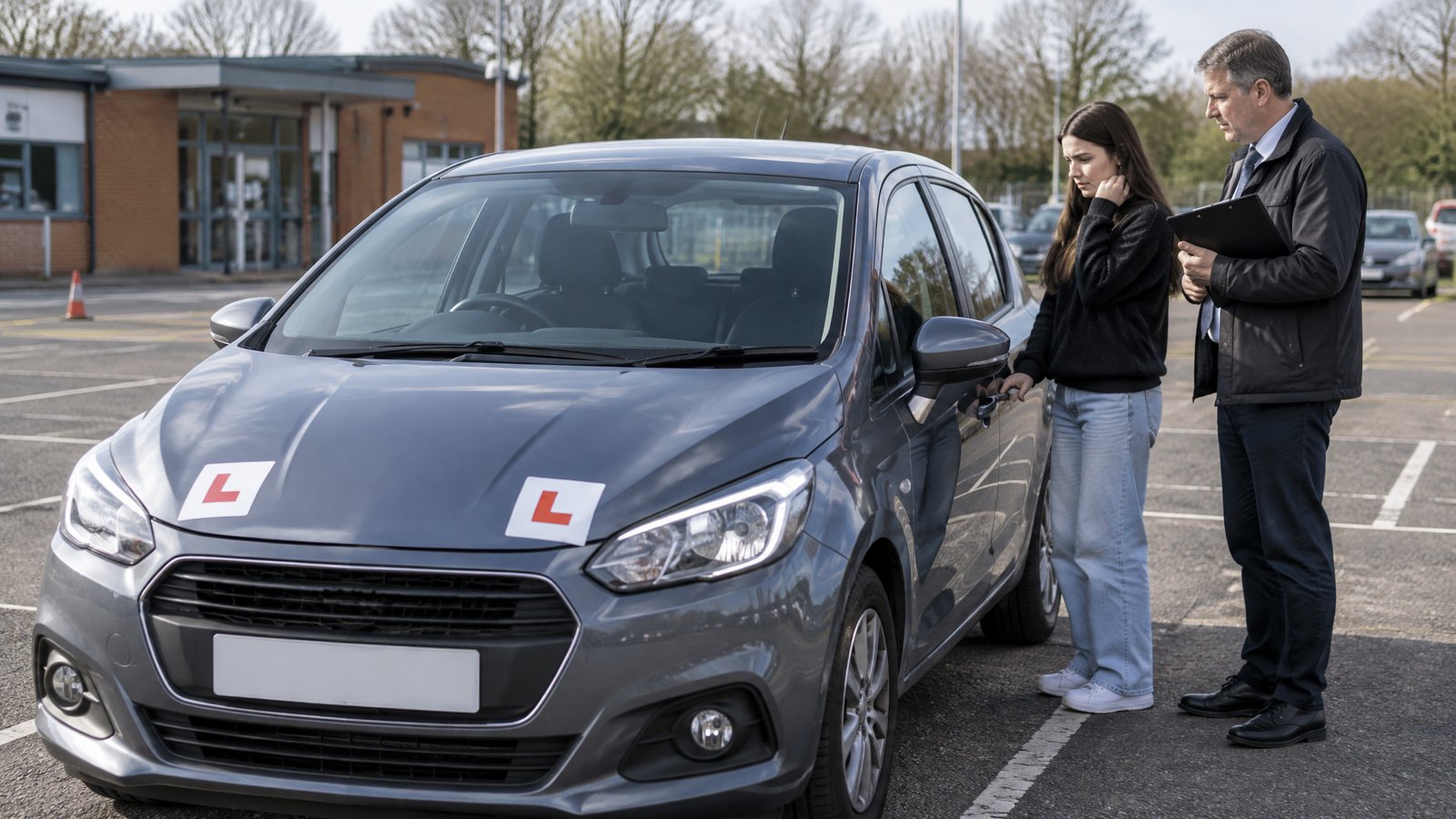
Step 1: The eyesight check
Before you get in the car, you must read a number plate from:
- 20 metres for a new-style plate (like AB51 ABC)
- 20.5 metres for an old-style plate
If you can't, you fail and the test ends there. If you need glasses or contact lenses to drive, wear them.
Example: 20 metres is about five car lengths. Practise reading number plates in a car park before your test.
Step 2: Show me, tell me
The examiner asks you 2 vehicle safety questions:
- one "tell me" question at the start, before you drive
- one "show me" question while you are driving
Tell me questions ask you to explain how you would check something on the car. They cover topics like:
- checking the tyres (pressure, tread and condition)
- checking that the brakes, steering and warning lights work
- setting the head restraint correctly
- checking the lights, indicators and brake lights
- checking fluid levels under the bonnet, like engine oil and coolant
Show me questions ask you to use a control while you're driving, when it is safe. They cover things like:
- using the windscreen washers and wipers
- switching on dipped headlights or the rear heater
- using the horn
- demisting the windscreen
- opening and closing a side window
If you get one or both wrong, you get one driving fault. But if you lose control of the car while doing a show me task, that could be a serious or dangerous fault.
Example: You're asked to demist the windscreen. Wait for a straight, quiet road, then do it quickly while keeping your eyes on the road.
See the full list on GOV.UK: Car show me, tell me questions.
Step 3: General driving
You drive on different types of road and in different traffic. The examiner gives you directions. You may be asked to:
- pull over at the side of the road
- pull out from behind a parked vehicle
- do a hill start
- do an emergency stop
Not every test has an emergency stop. DVSA's guidance for examiners says it is included in about 1 in every 7 tests. Be ready for it anyway.
Example: The examiner explains the signal before you start, then gives it without warning. Brake firmly and quickly, but stay in control of the car.
Step 4: Independent driving
GOV.UK says you'll drive on your own for 20 to 35 minutes. The examiner will ask you to follow either:
- directions from a sat nav, or
- traffic signs, or
- a mix of both.
The examiner sets up the sat nav. You can't use your own. If you can't see a sign, the examiner will help until you can see the next one.
Taking a wrong turn is not a fault, as long as you do it safely.
Example: The sat nav says "turn left", but you're in the wrong lane. Don't swerve. Carry on safely and the examiner will help you get back on route.
Step 5: The reversing manoeuvre
You will be asked to do one of these:
- Parallel park at the side of the road.
- Park in a bay, either driving in and reversing out, or reversing in and driving out.
- Pull up on the right side of the road, reverse about 2 car lengths, then rejoin the traffic.
Take your time and keep looking all around, not just in your mirrors.
Example: While reversing into a bay, a person walks behind the car. Stop and wait for them to pass.
How faults work
There are three types of fault:
- Driving fault (often called a "minor"): not dangerous, but not quite right. If you keep making the same one, it can become a serious fault.
- Serious fault: something that could have been dangerous.
- Dangerous fault: something that caused real danger to you, the examiner, the public or property.
To pass, you must have:
- no more than 15 driving faults, and
- no serious or dangerous faults.
Example: Jack gets 9 minor faults and passes. Ellie gets just 2 minors, but she pulls out in front of a car at a junction. That is a serious fault, so she fails.
If you make a small mistake, keep going. The examiner only stops the test early if your driving is dangerous.
The top 10 reasons people fail
DVSA publishes the most common reasons for failing. For tests from April 2024 to March 2025, the top 10 were:
- Not looking properly at junctions
- Not using mirrors correctly when changing direction
- Not moving off safely
- Wrong position when turning right at junctions
- Not reacting properly to traffic lights
- Not controlling the steering properly
- Not reacting properly to road markings
- Not reacting properly to traffic signs
- Poor position on the road during normal driving
- Not driving at a safe and suitable speed
Example: At a junction with parked cars blocking your view, creep forward slowly and look both ways more than once before you go.
Learn the signs and markings in our road signs guide, and test yourself with our free practice tests.
Tips for the day
- Have a warm-up lesson just before.
- Sleep well and eat something before you go.
- Arrive in good time with your licence.
- Ask the examiner to repeat an instruction if you didn't hear it. That's fine.
- Drive as you would in a lesson. Don't drive extra slowly to "be safe". Driving too slowly can be a fault too.
- Don't guess how you're doing. One mistake doesn't mean you've failed.
What happens after the test
If you pass, the examiner gives you a pass certificate. They will ask if you want your full licence sent to you automatically. You can drive on your own straight away, but only if your insurance covers you to drive without supervision.
If you don't pass, you will get feedback on what went wrong. You must book and pay for another test, at least 10 working days later.
Example: Fail on 2 March, and the earliest you can rebook is mid-March. Use the time to practise the faults you got.
Read next: New driver rules: your first two years.
Frequently asked questions
How long is the driving test?
You'll drive for around 35 minutes. Allow about 40 minutes for the whole test.
How many minors can I get and still pass?
Up to 15 driving faults, with no serious or dangerous faults.
Can my instructor book my test for me?
No. Since 12 May 2026, you must book and manage your own car test.
Is the emergency stop always included?
No. It's only in some tests, but you should be ready for one.
What if I go the wrong way during independent driving?
It's not a fault if you drive safely. The examiner will help you get back on route.
When can I retake the test if I fail?
You must choose a date at least 10 working days away.
More from Learn to drive
Sources
Official figures in this guide come from the sources below. Ranges and examples not linked to a source are general guidance from our editors, not official statistics.
- gov.uk/driving-test
- gov.uk/book-driving-test
- gov.uk/driving-test-cost
- gov.uk/change-driving-test
- gov.uk/driving-test/what-to-take
- gov.uk/driving-test/using-your-own-car
- gov.uk/driving-test/what-happens-during-test
- gov.uk/driving-test/driving-test-faults-result
- gov.uk/government/publications/car-show-me-tell-me-vehicle-safety-questions
- gov.uk/government/publications/top-10-reasons-for-failing-the-driving-test/top-10-reasons-for-failing-the-driving-test-in-great-britain
- gov.uk/guidance/guidance-for-driving-examiners-carrying-out-driving-tests-dt1/1-car-driving-test
- gov.uk/government/news/end-of-the-road-for-unofficial-driving-test-booking-services
- gov.uk/government/news/new-rule-for-driving-test-changes-and-cancellations-to-reduce-waiting-times
- gov.uk/driving-lessons-learning-to-drive/taking-driving-lessons