

UK road signs explained
There are hundreds of UK road signs, but you don't need to memorise them one by one. Signs follow a simple system of shapes and colours. Learn the system and you can work out most signs, even new ones.
Quick summary
- Circles give orders. A red ring means you must not. A blue circle means you must.
- Triangles warn you about a hazard ahead.
- Rectangles give information and directions.
- STOP and GIVE WAY have special shapes so they stand out.
- Road markings carry rules too, from white lines and zigzags to yellow lines and box junctions.
The sign system: shapes and colours
Circles give orders
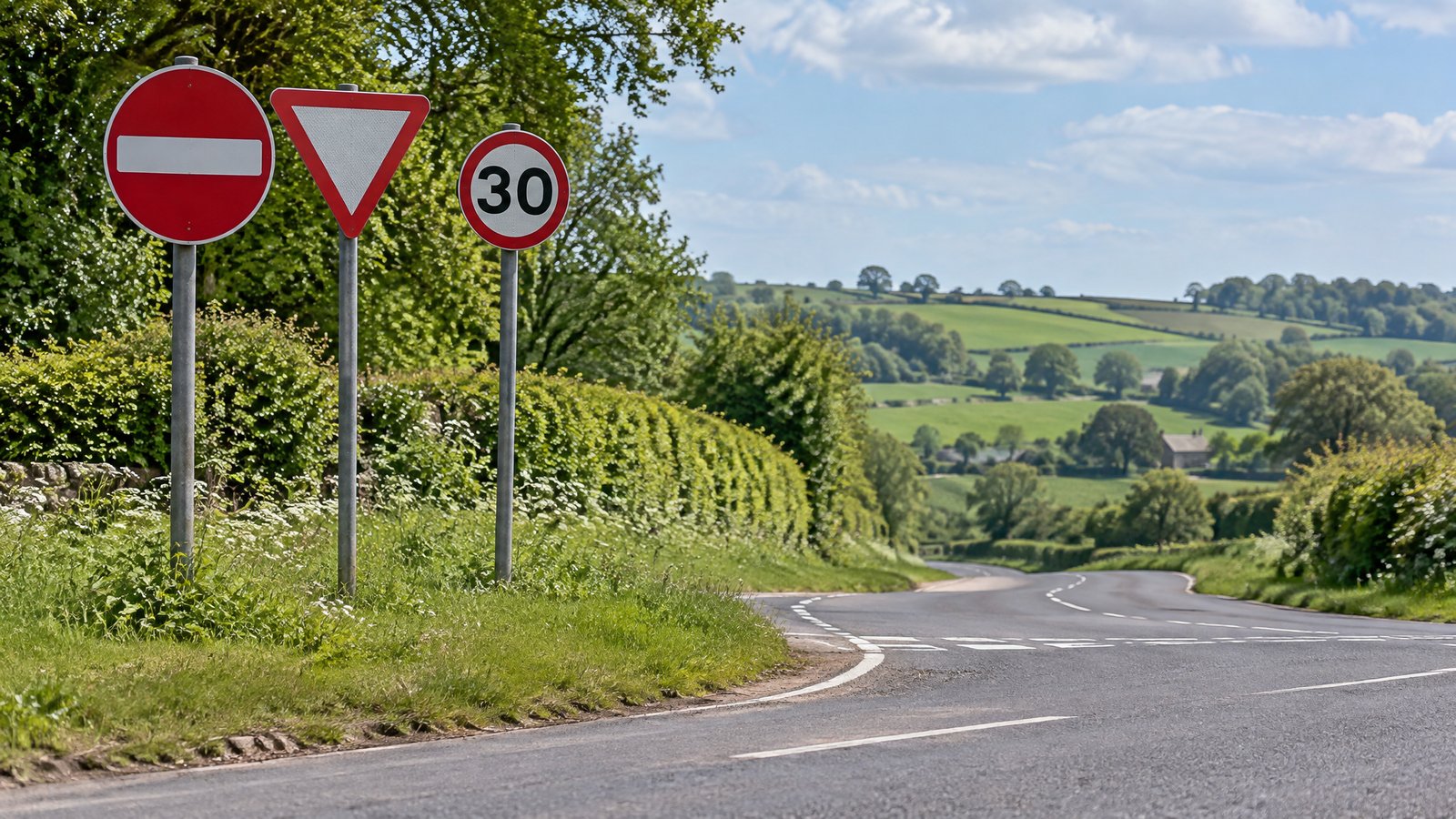
- Red ring = you must NOT. Example: "30" in a red ring means don't go over 30 mph.
- Blue circle = you MUST. Example: a white left arrow in a blue circle means turn left.
Triangles warn
Triangles with a red border warn you to be ready for something ahead. Example: a red triangle showing a T shape warns of a T-junction.
Rectangles inform
Rectangles give information or directions. On direction signs, the colour shows the type of road:
- Blue = motorways. (Elsewhere, blue rectangles give general information.)
- Green = primary routes, the main A roads.
- White = non-primary and local routes.
- Brown = tourist attractions.
Example: a brown sign to a castle.
One picture, three meanings
Same picture, different shape:
- A bicycle in a red ring = no cycling.
- A bicycle in a blue circle = route for bicycles only.
- A bicycle in a red triangle = watch out, cyclists ahead.
The two special shapes
Two important signs break the shape rules so they stand out more:
- STOP is an eight-sided shape (an octagon), red with white letters.
- GIVE WAY is an upside-down triangle with a red border.
25 important signs
Signs that tell you what you must not do (red rings)
1. No entry: A red circle with a white horizontal bar. No vehicles may enter. Example: the "wrong" end of a one-way street.
2. Maximum speed: A red ring with a number inside. Don't go faster than this speed. Example: "20" outside a primary school.
3. National speed limit applies: A white circle with a black diagonal stripe. The national limit applies (for cars, 60 mph on single carriageways, 70 mph on dual carriageways and motorways). Example: leaving a village onto an open country road.
4. No overtaking: A red ring with two cars side by side, one black and one red. Don't overtake moving vehicles. Example: a winding road with poor views.
5. No right turn: A red ring with a black arrow turning right, crossed by a red bar. You must not turn right here. Example: a busy junction.
6. No U-turns: A red ring with a U-shaped arrow, crossed by a red bar. You must not turn round in the road. Example: on a busy high street.
7. No motor vehicles: A red ring with a car and a motorbike inside. No motor vehicles allowed. Example: the entrance to a park path.
8. No waiting: A blue circle with a red border and one red diagonal line. You must not wait or park (check plates for the times). Example: outside a row of shops.
9. No stopping (clearway): A blue circle with a red border and a red cross. You must not stop on the main carriageway, even to drop someone off. Example: a fast main road.
10. Entry to 20 mph zone: A white rectangle with a red-ringed "20" and the word ZONE. 20 mph is the limit until a sign shows the zone ends. Example: a housing estate.
The special-shape signs
11. STOP: Red octagon with the word STOP. You must stop at the line, even if the road looks clear. Example: a junction with a poor view of the main road.
12. Give way: Upside-down triangle with a red border and the words GIVE WAY. Let traffic on the main road go first. Example: joining a main road from a side street.
Signs that tell you what you must do (blue circles)
13. Ahead only: Blue circle with a white arrow pointing up. You must go straight on. Example: where turning off would be unsafe.
14. Turn left ahead: Blue circle with a white arrow bending left. You must turn left ahead. Example: before a one-way system.
15. Keep left: Blue circle with a white arrow pointing down to the left. Pass to the left of the island or obstacle. Example: a traffic island.
16. Mini-roundabout: Blue circle with three white arrows going round clockwise. Give way to traffic from your right and go round the painted circle. Example: a small junction in a housing estate.
17. Route for cycles only: Blue circle with a white bicycle. Only bicycles can use this route. Example: a cycle path beside the road.
18. Minimum speed: Blue circle with a white number. You must not go slower than this unless it's unsafe. Example: a route where very slow vehicles would cause danger.
Signs that warn you (red triangles)
19. Crossroads: Red triangle with a cross shape. Roads cross ahead. Example: watch for cars from the left and right.
20. Roundabout: Red triangle with three arrows in a circle. Roundabout ahead. Example: slow down and choose your lane.
21. Road narrows on both sides: Red triangle with two lines getting closer. The road gets narrower ahead. Example: a narrow bridge.
22. Slippery road: Red triangle with a car and wiggly skid marks. The road may be slippery. Example: brake gently and gradually in the rain.
23. Traffic signals ahead: Red triangle with red, amber and green lights. Traffic lights ahead. Example: lights hidden around a bend.
24. Level crossing with barrier or gate: Red triangle with a picture of a gate. A railway crossing with barriers ahead. Example: be ready to stop when the lights flash.
25. Accompanied horses or ponies: Red triangle with a horse and rider. Horse riders may be on the road. Example: slow to no more than 10 mph and pass at least 2 metres away.
Road markings
Lines across the road
- Stop line (solid white): stop behind it at a STOP sign, traffic lights or level crossing.
- Give way line (double broken white): give way to the main road, or to traffic from the right at roundabouts.
White lines along the road
- Short broken centre line: marks the middle of the road. You may cross it to overtake if safe.
- Hazard warning line: longer dashes, shorter gaps. A hazard, like a bend or junction, is ahead. Only cross if the road is clearly safe.
- Double white lines with a broken line on your side: you may cross to overtake if it's safe and you can finish before a solid line on your side.
- Double white lines with a solid line on your side: you must not cross or straddle it, except in a few cases, such as turning into a side road, passing a stationary vehicle, or overtaking a cyclist, horse or road maintenance vehicle going at 10 mph or less.
- Diagonal stripes or chevrons: keep out. With a solid white border, you must not enter except in an emergency.
Example: Solid white line on your side and a slow car in front? Don't overtake. Be patient.
Yellow lines and kerb marks
- Double yellow lines: no waiting at any time.
- Single yellow line: no waiting during the times shown on nearby plates.
- Yellow marks on the kerb: no loading or unloading at the times shown. Passengers can still get in or out.
- Double red lines (red routes): no stopping at any time.
Example: On double yellows you can usually stop briefly to let a friend out, unless signs ban stopping (for example on a red route or clearway).
Zigzag lines
- White zigzags at a crossing: don't park or stop on them, or overtake the vehicle nearest the crossing.
- Yellow zigzags with "SCHOOL KEEP CLEAR": where signs ban stopping, don't stop there, even to drop off or pick up children.
Box junctions
A box junction has yellow criss-cross lines. Don't enter unless your exit is clear. Exception: when turning right, you can wait in the box if only oncoming traffic or other right-turners are stopping you.
Example: Traffic is queuing beyond the junction. Wait before the box, even on green.
Traffic lights
Traffic lights follow the same order every time:
- Red: stop and wait behind the white stop line.
- Red and amber together: still stop. Don't go until green shows.
- Green: go if the way is clear. When turning, give way to people crossing.
- Amber on its own: stop at the line, unless you've already crossed it or are too close to stop safely.
- Then back to red.
A green arrow lets you go in that direction only. If lights are not working, treat the junction as unmarked and take great care.
Example: The light turns amber and you can stop safely. Stop. Amber means stop, not speed up.
Signals from police and other officers
- Police officer on foot: arm signals can stop traffic from the front, behind or both, or wave traffic on. The Highway Code shows each one.
- Police car behind you: flashing blue lights, headlights or siren, perhaps with a pointing hand or left indicator. Pull over when safe and switch off your engine.
- DVSA officers and traffic officers: they use flashing amber lights. Traffic officers work on motorways and some A roads in England and Wales. You must obey them.
- School crossing patrol: you must stop when they show their "Stop for children" sign.
Example: If a police officer is directing traffic at broken lights, follow the officer.
Test yourself with our free practice tests, then read about the theory test and driving test.
Frequently asked questions
What's the easiest way to learn road signs?
Learn the system first: circles order, triangles warn, rectangles inform. Then learn the common signs.
What does a red ring mean?
It tells you what you must not do, like going over a speed limit.
What does a blue circle mean?
It tells you what you must do, like turn left, or marks a route for certain vehicles, like bikes.
Can I cross a solid white line?
Not if it's on your side, except in a few cases, like passing a stationary vehicle.
Where can I see every official sign?
In Know Your Traffic Signs, free on GOV.UK.
More from Learn to drive
Sources
Official figures in this guide come from the sources below. Ranges and examples not linked to a source are general guidance from our editors, not official statistics.
- gov.uk/guidance/the-highway-code
- gov.uk/guidance/the-highway-code/traffic-signs
- gov.uk/guidance/the-highway-code/road-markings
- gov.uk/guidance/the-highway-code/light-signals-controlling-traffic
- gov.uk/guidance/the-highway-code/signals-by-authorised-persons
- gov.uk/guidance/the-highway-code/general-rules-techniques-and-advice-for-all-drivers-and-riders-103-to-158
- gov.uk/guidance/the-highway-code/using-the-road-159-to-203
- gov.uk/guidance/the-highway-code/road-users-requiring-extra-care-204-to-225
- gov.uk/guidance/the-highway-code/waiting-and-parking-238-to-252
- gov.uk/government/publications/know-your-traffic-signs
- gov.uk/government/publications/know-your-traffic-signs/the-signing-system
- gov.uk/speed-limits