

The V5C Logbook Explained: What It Is and How to Use It
The V5C is the most important document that comes with a used car. It links a registration number to a specific vehicle and keeper, and it is how DVLA learns the car has changed hands. Here is what is on it, what to check before paying, how to sell properly, how to replace a lost one and why buying without one is a gamble.
What is a V5C?
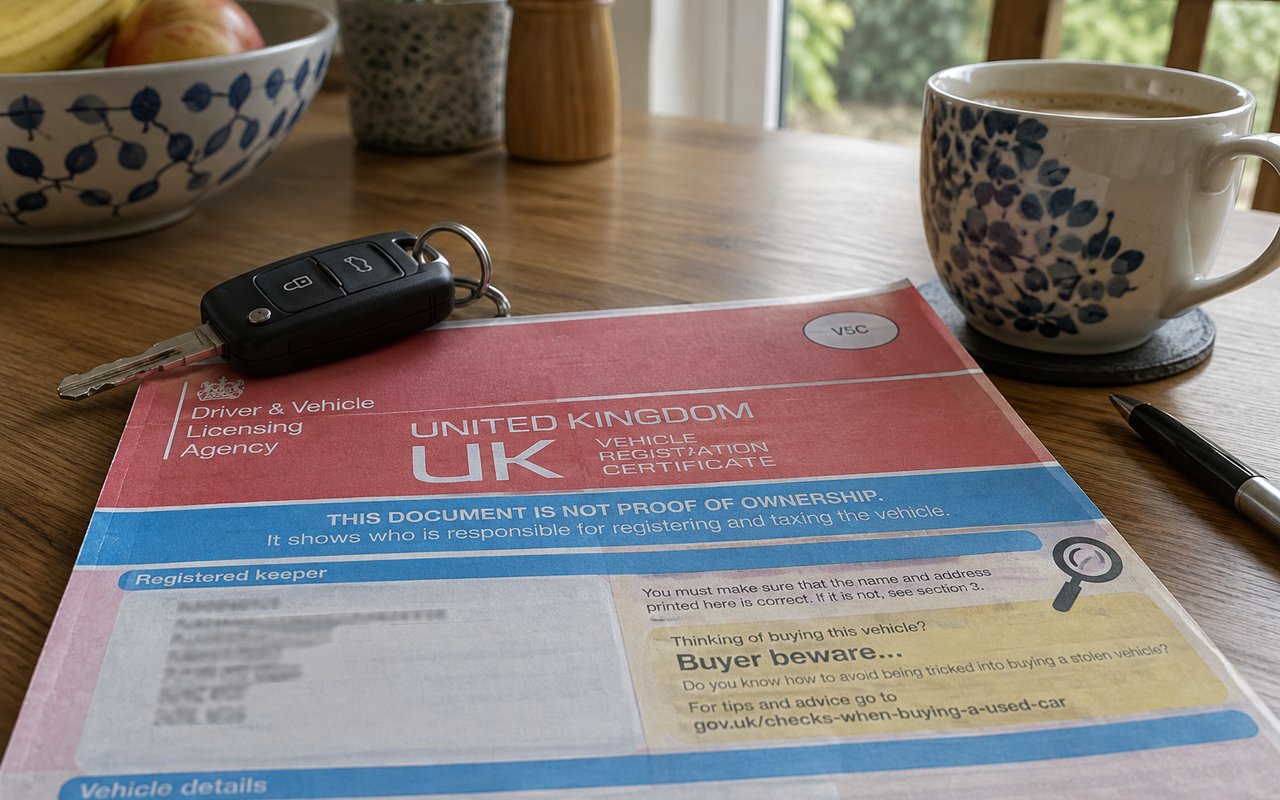
The V5C, officially the vehicle registration certificate and usually called the logbook, is issued by the Driver and Vehicle Licensing Agency (DVLA). It records who the registered keeper is and the key details of the vehicle, including the registration number, make, model, colour, engine size, fuel type, VIN (vehicle identification number) and the date of first registration. The front page also shows how many former keepers the car has had.
The registered keeper is the person responsible for the car, not necessarily its legal owner. A company car or a car on finance may have a keeper who does not own it, so a V5C alone does not prove the seller is entitled to sell.
The sections of the V5C
The current-style V5C is split into numbered sections, each with a specific job. Layouts have changed over the years, so the numbering on an older logbook may differ, but the current version is broadly arranged like this:
- Front page (keeper and vehicle details). The registered keeper's name and address, the vehicle's details, the number of previous keepers and any special notes.
- Section 1 – changes to the vehicle. Used to tell DVLA about changes such as a new colour or a different engine.
- Section 2 – selling to a private buyer. Where the seller records the new keeper's details and the date of sale.
- Section 3 – change of the keeper's name or address.
- Section 4 – selling to a motor trader. The yellow "sell, transfer or part-exchange" section, used when the car goes to a trader, insurer or dismantler.
- Section 5 – permanent export.
- Section 6 – the new keeper slip. The green slip that the seller tears off and gives to the buyer.
The green new keeper slip
The new keeper slip is the buyer's proof that the change of keeper is under way. GOV.UK tells buyers to use it to tax the vehicle straight away, because vehicle tax does not transfer with the car. Keep it safe until your own V5C arrives. If you ever need to apply for a logbook on form V62 because one never arrived, sending the slip from the most recent V5C supports your application.
What to check on a V5C when buying a used car
GOV.UK's guidance on checking a used vehicle is the best starting point. Work through these checks before any money changes hands.
Check the document is genuine
- Hold it up to the light: it should carry a "DVL" watermark.
- Check the serial number. GOV.UK warns that a V5C with a serial number in the range BG8229501 to BG9999030, or BI2305501 to BI2800000, might be stolen. If it falls in either range, do not buy the car and contact the police when it is safe to do so.
Match the VIN and engine number
Every vehicle registered in the UK must have a unique VIN stamped into the vehicle. Find it on the car (commonly at the base of the windscreen, on a plate in a door pillar or stamped into the floor or engine bay) and compare every character with the logbook. Do the same with the engine number. A mismatch, a VIN plate that looks tampered with or scratched digits are serious warning signs of a cloned or stolen car.
Check the keeper history
- Does the name on the V5C match the seller? If not, ask why.
- Is the address the one you are viewing the car at? Seeing the car at the registered address is a sensible precaution.
- Does the number of previous keepers fit the story you have been told?
- Use the DVLA vehicle enquiry service to see the date the last V5C was issued. If it is very recent and the seller claims to have owned the car for years, find out why a new logbook was needed.
Check colour, engine and other details
Compare what you see with what is written. Keepers must update the V5C after changing the colour, engine, cylinder capacity, fuel type, seating capacity or certain structural parts. A blue car recorded as silver, or a larger engine than the logbook states, suggests undeclared modifications or a car that is not what it claims to be.
Cross-check with official records
GOV.UK also recommends checking that the details you have been given match DVLA's records, reviewing the MOT history and checking whether the vehicle has an outstanding safety recall. The V5C will not tell you about outstanding finance or past insurance write-offs, which is where a private history check comes in. Once you know the car's history, value it on moValue so you can judge whether the asking price is fair.
Selling a car: what to do with the V5C
- Tell DVLA. The quickest route is DVLA's online service, available Monday to Friday 7am to 9pm and at weekends 7am to 8pm. Have the V5C in front of you, as you will need details from it. You cannot use the online service if you have already posted the logbook or do not have one.
- Give the buyer the green new keeper slip. They need it to tax the car.
- Sold to a trader? Complete the yellow section if notifying by post; DVLA's online service also covers sales to motor traders.
- Without a logbook? Write to DVLA, Swansea, SA99 1BA, giving your name and address, the registration number, make and model, the exact date of sale and the name and address of the new keeper or motor trader.
- Tax refund. Your vehicle tax is cancelled once DVLA knows you have sold the car, and you can get a refund for any full months left.
When the seller notifies DVLA online, the buyer's new V5C usually arrives within 5 to 7 working days. If the change is made by post, GOV.UK says it usually takes up to 4 weeks.
Replacing a lost, stolen or damaged V5C
Online or by phone
If you are the registered keeper and none of the details need changing, you can apply online or by phone. You will need the registration number, the VIN and the name and postcode on the V5C. The fee is usually £25, paid by debit or credit card, and the replacement normally arrives within 5 to 7 working days. The fee is not refunded if you later find the original. You cannot apply online if you need to change details, do not have the vehicle, have already sent the V5C to DVLA, or the vehicle is registered abroad.
By post using form V62
If you need to change details, or you are a new keeper whose V5C never arrived, you apply by post using form V62 (Application for a vehicle registration certificate). Send it to DVLA, Swansea, SA99 1DD, with a £25 cheque or postal order payable to "DVLA, Swansea" where a fee applies. A new keeper who encloses the correct green slip from the most recent V5C should not need to pay. Postal applications usually take around 4 weeks.
If it does not arrive
Contact DVLA if your logbook has not turned up when expected. GOV.UK warns that if you have not received it after 6 weeks and have not told DVLA, you will have to pay £25 for another one, so do not leave it.
Buying a car without a V5C: the risks
GOV.UK advises against buying a vehicle without a V5C. If you do, you will need to apply for one yourself on form V62, paying £25. The bigger problem is what a missing logbook might be hiding:
- The car may be stolen. A genuine keeper can get a replacement within a week, so "it's lost in the post" is a weak excuse.
- You cannot confirm identity. Without the logbook you cannot match the VIN, engine number and keeper details.
- There may be finance outstanding. If a lender still owns the car, it could be repossessed.
- It may have been written off or have a cloned identity.
If the seller has no logbook, ask them to get a replacement and come back when it arrives.
Frequently asked questions
Does the V5C prove ownership?
No. It shows the registered keeper, who is responsible for the vehicle, but that person may not be the legal owner, for example if the car is on finance or a company vehicle.
How much does a replacement V5C cost?
Usually £25, whether you apply online, by phone or by post. The fee is not refunded if you find the original afterwards.
How long does a new V5C take to arrive?
Usually 5 to 7 working days for online or phone applications, and around 4 weeks for postal applications.
What do I do with the green slip when I buy a car?
Use it to tax the car immediately, and keep it until your own V5C arrives. It also supports a V62 application if the logbook never turns up.
Do I need to tell DVLA if I change my car's colour?
Yes. Changes to colour, engine, cylinder capacity, fuel type and seating capacity must be recorded on the V5C.
Can I sell a car without a V5C?
Yes, but you must write to DVLA in Swansea with the sale details. Buyers will be understandably wary, so it is usually better to get a replacement first.
Related Guides
Sources
Official figures in this guide come from the sources below. Ranges and examples not linked to a source are general guidance from our editors, not official statistics.
- GOV.UK, Get a vehicle log book (V5C)
- GOV.UK, If you cannot get a log book online
- GOV.UK, Application for a vehicle registration certificate (V62)
- GOV.UK, Tell DVLA you've sold, transferred or bought a vehicle
- GOV.UK, Check a used vehicle you're buying
- GOV.UK, Vehicle registration – new and used vehicles
- GOV.UK, Vehicle identification number
- GOV.UK, Change vehicle details on a V5C
- GOV.UK, Get vehicle information from DVLA
- Parkers, What is a V5C document (section layout)