

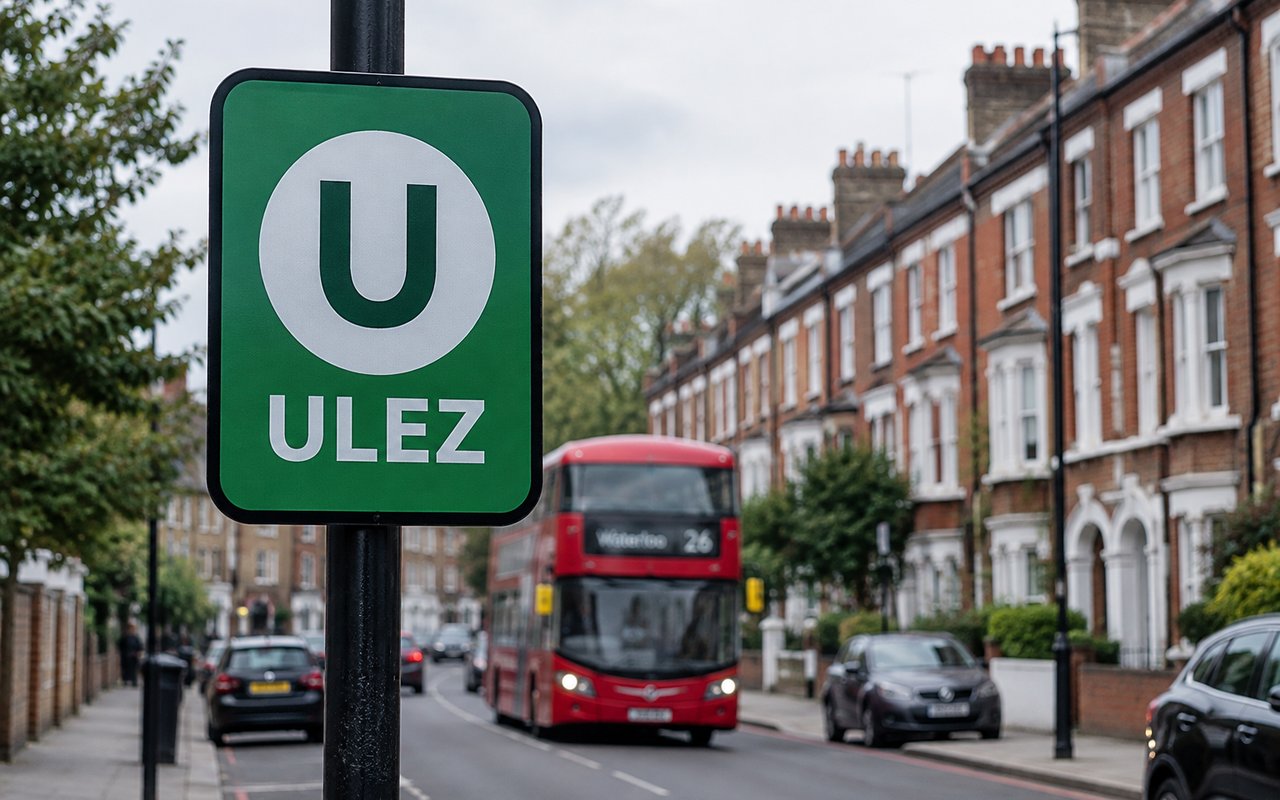
ULEZ, LEZ and Clean Air Zones in the UK (2026): what drivers need to know
Clean air zones are now a normal part of driving in many UK cities, but the rules differ a lot between them. Some charge private cars every day, some only charge taxis, vans and lorries, and the Scottish zones don't let you pay at all: you get a fine instead. This guide explains how the zones work, which emission standards matter, every zone that is active in October 2026, and what a non-compliant car means for its value when you come to sell.
Figures checked against official council, TfL, GOV.UK and Scottish Government pages on 23 October 2026. Charges can change, so always confirm with the official checker before you travel.
What are ULEZ, LEZ, CAZ and ZEZ?
They're all schemes that charge or penalise the most polluting vehicles in a defined area. The names differ because they were set up under different rules.
ULEZ (London)
London's Ultra Low Emission Zone is run by Transport for London (TfL). It now covers all London boroughs and the City of London, but not the M25. It runs 24 hours a day, every day of the year except Christmas Day. A car, van or motorcycle that doesn't meet the standard costs £12.50 per day, with each day running from midnight to midnight. If you don't pay, the penalty is £180, reduced to £90 if paid within 14 days.
LEZ (London and Scotland)
London's Low Emission Zone is a separate, older scheme aimed at heavier vehicles such as lorries, buses and coaches. It doesn't affect ordinary cars or motorcycles.
In Scotland, "LEZ" means something different. Glasgow, Edinburgh, Aberdeen and Dundee each have a Low Emission Zone that covers cars. You cannot pay to enter. If a non-compliant vehicle drives in, the registered keeper gets a penalty charge notice.
CAZ (England outside London)
Clean Air Zones are run by local councils under a national framework. Each one has a class:
- Class A: buses, coaches, taxis and private hire vehicles
- Class B: Class A plus HGVs
- Class C: Class B plus vans and minibuses
- Class D: Class C plus private cars (councils can also choose to include motorcycles)
For a private car driver, only a Class D zone costs anything. At the moment that means Birmingham and Bristol.
ZEZ (Oxford)
Oxford runs a small pilot Zero Emission Zone in the city centre. It works differently: almost every petrol or diesel vehicle pays something, including ones that meet Euro 4 or Euro 6, and only zero-emission vehicles go free.
Which emission standards do you need?
The standards used by ULEZ, the English CAZs and the Scottish LEZs are much the same for cars:
| Vehicle | Minimum standard |
|---|---|
| Petrol car or van | Euro 4 |
| Diesel car or van | Euro 6 |
| Motorcycle (ULEZ; and Class D CAZs where the council chooses to charge them) | Euro 3 |
| Bus, coach, HGV | Euro VI |
Fully electric and hydrogen vehicles meet every standard. Hybrids are judged by their petrol or diesel engine.
Working it out from the registration year (with caveats)
As a rough guide used by TfL, Bristol City Council and Transport Scotland:
- Petrol cars registered from around 2006 onwards usually meet Euro 4. Many 2001–2005 petrol cars meet it too.
- Diesel cars registered from around September 2015 onwards usually meet Euro 6.
- Motorcycles registered with the DVLA after July 2007 are generally Euro 3, according to TfL.
Treat these dates as a starting point only. TfL says plainly that the ULEZ is enforced on a vehicle's declared emissions, not its age. So a 2016 diesel that was built to Euro 5 and registered late can still be charged, while some earlier diesels sold as Euro 6 ahead of the deadline are compliant. Imports, personal imports and converted vehicles are the cases most likely to be wrong. Your V5C logbook may show the Euro standard; if not, the official checkers below give a definite answer for your registration number.
Every active clean air zone in the UK (October 2026)
| City | Type / class | Vehicles charged or penalised | Daily charge for a non-compliant car | Private cars charged? | Official link |
|---|---|---|---|---|---|
| London | ULEZ | Cars, vans, motorcycles, minibuses and other light vehicles | £12.50 | Yes | tfl.gov.uk |
| London | LEZ | Lorries, buses, coaches and other heavy vehicles | n/a | No | tfl.gov.uk |
| Birmingham | CAZ Class D | Cars, taxis, vans (£8); buses, coaches, HGVs (£50) | £8 | Yes | birmingham.gov.uk |
| Bristol | CAZ Class D | Cars, taxis, vans (£9); buses, coaches, HGVs (£100) | £9 | Yes | bristol.gov.uk |
| Bath | CAZ Class C | Taxis, minibuses, vans (£9); buses, coaches, HGVs (£100) | No charge | No | bathnes.gov.uk |
| Bradford | CAZ Class C | Taxis (£7); vans and minibuses (£9); buses, coaches, HGVs (£50) | No charge | No | bradford.gov.uk |
| Sheffield | CAZ Class C | Taxis and vans (£10); buses, coaches, HGVs (£50) | No charge | No | sheffield.gov.uk |
| Newcastle & Gateshead (Tyneside) | CAZ Class C | Taxis and vans (£12.50); buses, coaches, HGVs (£50) | No charge | No | gateshead.gov.uk |
| Portsmouth | CAZ Class B | Taxis (from £10); buses, coaches, HGVs (£50) | No charge | No | gov.uk |
| Glasgow | LEZ | All vehicles except motorcycles and mopeds | No charge available: £60 penalty | Yes (penalty) | glasgow.gov.uk |
| Edinburgh | LEZ | All vehicles except motorcycles and mopeds | No charge available: £60 penalty | Yes (penalty) | edinburgh.gov.uk |
| Aberdeen | LEZ | As above | No charge available: £60 penalty | Yes (penalty) | lowemissionzones.scot |
| Dundee | LEZ | As above | No charge available: £60 penalty | Yes (penalty) | lowemissionzones.scot |
| Oxford | Pilot ZEZ (7am–7pm) | Almost all non-zero-emission vehicles | £2 (under 75g/km CO2), £4 (Euro 4 petrol / Euro 6 diesel), £10 (all others) | Yes | oxfordshire.gov.uk |
A few points worth knowing:
- Scotland's penalties escalate. The first penalty is £60 (£30 if paid within 14 days). Each further entry by the same vehicle into the same zone within 90 days doubles it, up to £480 for cars and vans and £960 for buses, coaches and HGVs. Enforcement began in Glasgow on 1 June 2023, Dundee on 30 May 2024, and Aberdeen and Edinburgh on 1 June 2024.
- Cars in Class C zones aren't always safe. Bath and Sheffield both warn that some vehicles that look like cars, such as certain pick-ups, SUVs or campervans, are registered as light goods vehicles and can be charged.
- Taxis and private hire cars pay in every English CAZ, even when used privately.
- Oxford's wider ZEZ is still only a proposal. The council's timetable has a revised consultation being prepared from spring 2026, with no start date set.
- Greater Manchester has no charging zone; GOV.UK removed it from the list in February 2025 after a non-charging plan was approved.
How a non-compliant car affects resale value
A car that fails ULEZ or a Class D CAZ hasn't changed mechanically, but its pool of likely buyers has. That matters more for price than almost anything else.
Why demand drops. Anyone who lives in or commutes into London, Birmingham, Bristol or a Scottish city faces either a daily charge or an escalating fine. At £12.50 a day, a London commuter would spend more on charges in a year than many older diesels are worth. Those buyers won't consider the car, so sellers in and around those cities are competing for a smaller group of people, and dealers there are often reluctant to stock non-compliant cars.
Which cars are hit hardest. The most exposed are Euro 5 diesels from roughly 2010–2015: they're still recent enough to be worth a meaningful amount, yet they fail every car-charging zone. Early-2000s petrol cars are less affected because many already meet Euro 4, and those that don't are usually worth little anyway.
Where they're still easy to sell. Away from the charging zones, a non-compliant car is just a normal used car. Rural areas, smaller towns and most of England, Wales and Northern Ireland have no car-charging zone at all. Cars in Bath, Bradford, Sheffield, Newcastle and Portsmouth aren't charged either, so local buyers there often don't care about Euro ratings. Workhorse diesels with a good towing capacity, 4x4s and estates still find buyers in the countryside. Specialist trade buyers and auctions will also take them, though usually at a trade price.
What this means for sellers. If your car is non-compliant and you're near a charging zone, advertising it more widely or selling to a national buyer usually works better than relying on local demand. If your car is compliant, say so clearly in the advert, ideally with a screenshot from the official checker. A borderline car with proof of compliance (for example a 2005 petrol that passes) is easier to sell than one where the buyer has to take your word for it.
Buying used near a zone? Check compliance yourself before paying, as some sellers get it wrong, and check the car's history at the same time.
How to check your car
Use the official checker for the zone you're driving into. Each one only looks at its own scheme:
- London (ULEZ and LEZ): TfL's vehicle checker at tfl.gov.uk/modes/driving/check-your-vehicle.
- English Clean Air Zones (Bath, Birmingham, Bradford, Bristol, Portsmouth, Sheffield, Tyneside): the GOV.UK service at gov.uk/check-clean-air-zone-charge, which also takes payment and shows maps.
- Scottish LEZs: the national checker linked from lowemissionzones.scot.
- Oxford ZEZ: Oxfordshire County Council's "check your vehicle and pay" service, linked from oxfordshire.gov.uk.
If the result surprises you, look at your V5C. If it lists a Euro standard or NOx figure that disagrees with the checker, TfL and the councils accept evidence such as a manufacturer's certificate of conformity.
Once you know where your car stands, get a free valuation from moValue. It shows private sale, part-exchange and instant-buy values in one place, so you can see what your car is worth to the national market rather than just to dealers near a zone.
Frequently asked questions
Does ULEZ apply to petrol cars?
Yes, but most petrol cars pass. A petrol car needs to meet Euro 4, which most cars registered from around 2006 do, as do many from 2001 onwards. Always confirm with TfL's checker, as the date is only a guide.
Is my 2015 diesel ULEZ compliant?
Possibly. Diesel cars generally became Euro 6 from September 2015, but some models registered before that date were Euro 6 and some registered later were not. Only the registration-number checker gives a reliable answer.
Do motorcycles have to pay?
In London, motorcycles must meet Euro 3 (most bikes registered after July 2007 do) or pay £12.50 a day. Bristol, Bath and Bradford don't charge motorbikes, and the Scottish LEZs exclude motorcycles and mopeds.
Can I pay to drive into a Scottish LEZ?
No. There's no daily charge option in Glasgow, Edinburgh, Aberdeen or Dundee. A non-compliant vehicle gets a £60 penalty, which doubles for repeat entries within 90 days.
Which English cities charge private cars?
Only Birmingham (£8 a day) and Bristol (£9 a day) among the Clean Air Zones, plus London's ULEZ (£12.50) and Oxford's pilot ZEZ. Bath, Bradford, Sheffield, Newcastle/Gateshead and Portsmouth don't charge private cars.
Will a non-compliant car be hard to sell?
It's harder near charging zones and in Scottish cities, where many buyers rule it out. Elsewhere in the UK demand is much more normal. Selling through a national service and being upfront about compliance usually gets the best result.
Related Guides
Sources
Official figures in this guide come from the sources below. Ranges and examples not linked to a source are general guidance from our editors, not official statistics.
- GOV.UK, Driving in a clean air zone (updated 12 February 2026)
- GOV.UK, Check if you need to pay to drive in a clean air zone
- TfL, Ultra Low Emission Zone
- TfL, ULEZ where and when
- TfL, ULEZ cars
- TfL, ULEZ motorcycles, mopeds and more
- TfL, ULEZ online factsheet Jul–Sep 2024 (PCN amounts)
- Birmingham City Council, A Clean Air Zone for Birmingham
- Birmingham City Council, Payments for the Clean Air Zone go live
- Bristol City Council, Charges and vehicle checker
- Bath & North East Somerset Council, Bath Clean Air Zone
- Bath & North East Somerset Council, CAZ charges
- Bradford Council, CAZ FAQs
- Sheffield City Council, CAZ charges and how to pay
- Gateshead Council, The Clean Air Zone is now live
- Wightlink, Portsmouth Clean Air Zone (secondary; Portsmouth council page unreachable)
- Glasgow City Council, LEZ
- City of Edinburgh Council, LEZ
- Traffic Scotland, What are low emission zones
- mygov.scot, Fines for Low Emission Zones
- LEZ Scotland general flyer
- Oxfordshire County Council, Oxford ZEZ pilot
- Oxfordshire County Council, Proposed wider ZEZ